Drywall Anchors: What To Know Before You Buy | The Family Handyman
Every editorial production is independently selected, though we may be compensated or receive an affiliate commission if you purchase something through our links. Ratings and prices are authentic and items are in stock as of time of publication.
Drywall anchors allow yous to hang items safely and deeply without having to locate studs.
Drywall revolutionized residential home edifice in the 1940s and 50s. Gypsum panels provided simple, affordable wall coverings that went upwards far faster than traditional lath and plaster. This reduced labor and material costs, which led to lower home prices. Millions of mail service-war home buyers loved the solid, durable surface drywall provided.
Merely there'due south 1 area where drywall does not excel: Fastener retention.
Dry, crumbly gypsum doesn't provide enough stable material for a fastener to latch on to. If yous put a nail or screw in drywall. it won't support more than than a few pounds of weight, and it's uncomplicated to pull information technology directly out.
A lone fastener might exist secure plenty to hold a wall calendar. Only what if you desire to hang something heavier, or something valuable? You tin boom through the drywall and into a wall stud. Simply if your family heirloom doesn't line up conveniently with a stud, you need a better respond.
Enter the drywall anchor.
What are Drywall Anchors?
Any time you set a fastener like a nail or screw into a material that doesn't concur tight, you use an ballast to concur it in place. That's why materials such as drywall, brick and concrete demand anchors.
Drywall anchors (sometimes simply called wall anchors) come in many designs that all work on the aforementioned principle: They hold the fastener steady, then distribute pressure to the dorsum and sides of the drywall, spreading its weight-load beyond a wider area. The same concept applies to laying down on thin ice. Distributing the weight over a wider area makes it less probable to break through.
German inventor Artur Fischer patented the drywall anchor as nosotros know information technology in 1958. Fischer'southward expanding nylon plug was the first of many designs that let DIYers to hang about anything from their walls.
Types of Drywall Anchors
Many types of drywall anchors are available for habitation utilize, each with unlike weight ratings.
Expansion anchors
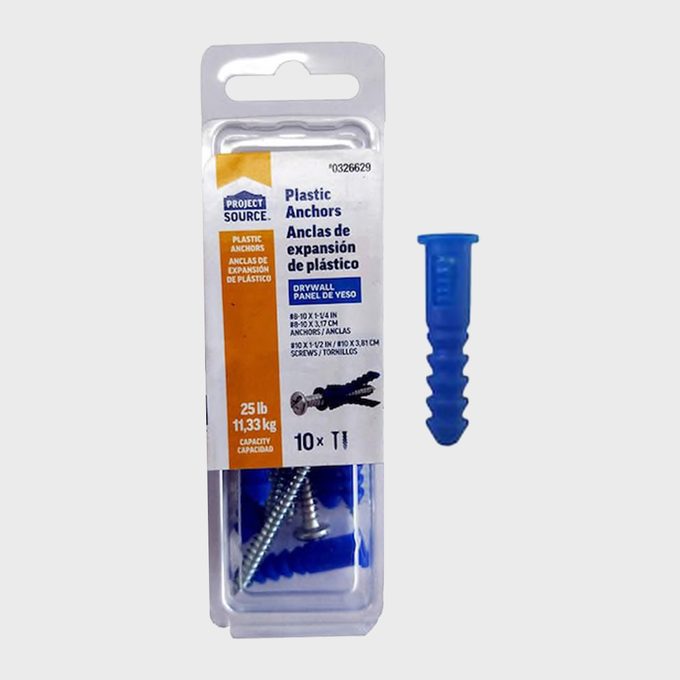
This is what almost homeowners think of when they picture a drywall anchor, the kind that ships free with near towel rods and toilet newspaper hangers.
Essentially sparse plastic sleeves, these anchors sit in the drywall hole and expand slightly when you drive a screw into them, calculation force per unit area against the side of the hole and holding house. Extremely affordable, they too have a lower holding weight than other anchors.
This ten-pack from Lowe's private brand Project Source is rated for 25 lb. hanging capacity.
Toggle-bolts
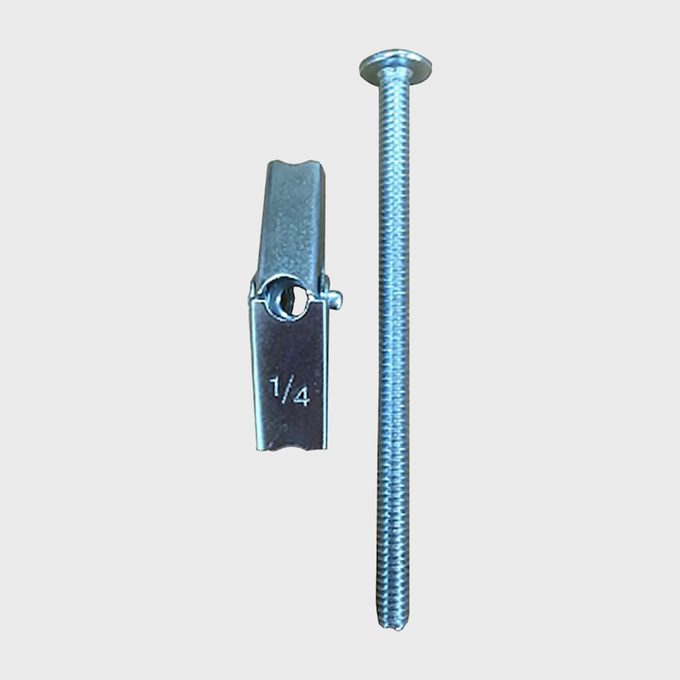
These anchors come as long bolts driven through a threaded toggle. The toggle folds in half, then uses a jump to popular open afterwards beingness inserted into the wall, distributing its weight behind the drywall.
Toggle-bolts require a larger hole than well-nigh anchors due to the size of the leap-loaded section. Removing the bolt means the toggle is lost behind the wall.
A good case is this set from Blue Hawk, which requires a three-quarter inch hole drilled in the drywall. Information technology's rated for lxx lb. hanging capacity.
Pull-toggle anchors
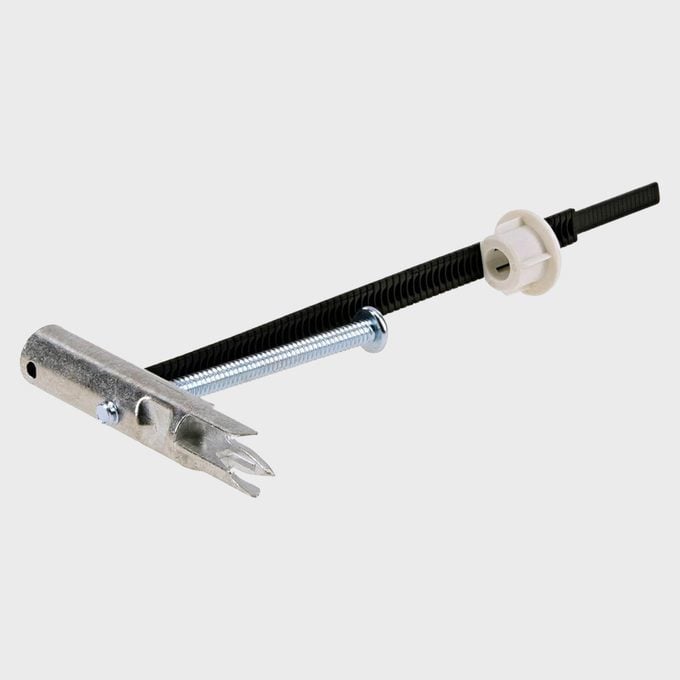
A relatively new entry in the drywall anchor market, these combine toggle-bolts and plastic anchors. The metal toggle is inserted into the wall but like a toggle-bolt. But instead of the metal bolt securing information technology in place, a plastic strap (similar to a zero-tie) pulls the toggle tight to the wall, connecting information technology to a threaded plastic servant.
This installation method allows a single-piece toggle, giving a stronger hold and requiring a smaller entry hole. That provides the strength of a toggle commodities with the reusability of a plastic anchor.
This Hillman pull-toggle just requires a 1-one-half inch entry, and can concord 120 lbs.
Metal anchors (Molly bolts)
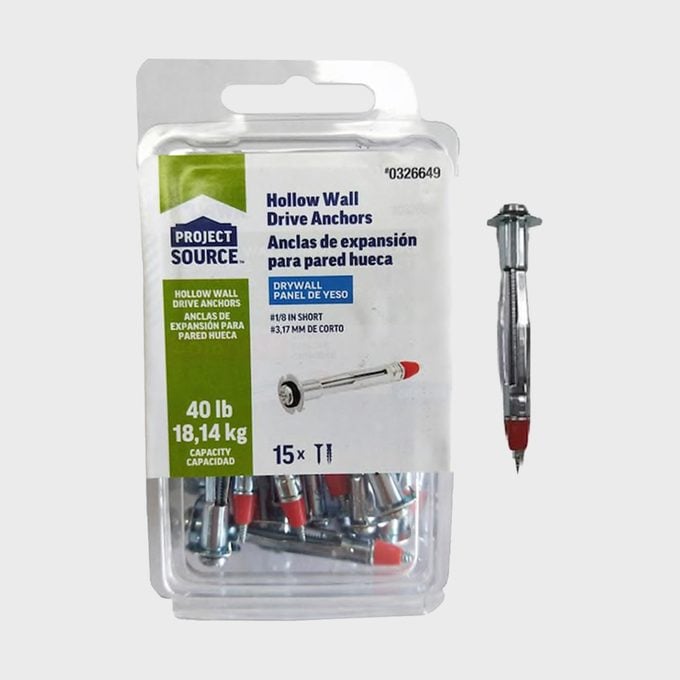
Molly bolts accept been around for almost a century. They resemble metal versions of expansion anchors. But instead of pressing against the sides of the entry hole, they actually flare the anchor barrel, creating a wider agree pattern behind the wall.
"Molly Bolt" was originally a make name, only it now commonly refers to any metal drywall anchors of this style, such as these anchors from Blueish Hawk. These are light-duty anchors designed to hold about 20 lbs. Larger, more robust Molly bolts can concur heavier loads.
Self-drilling anchors
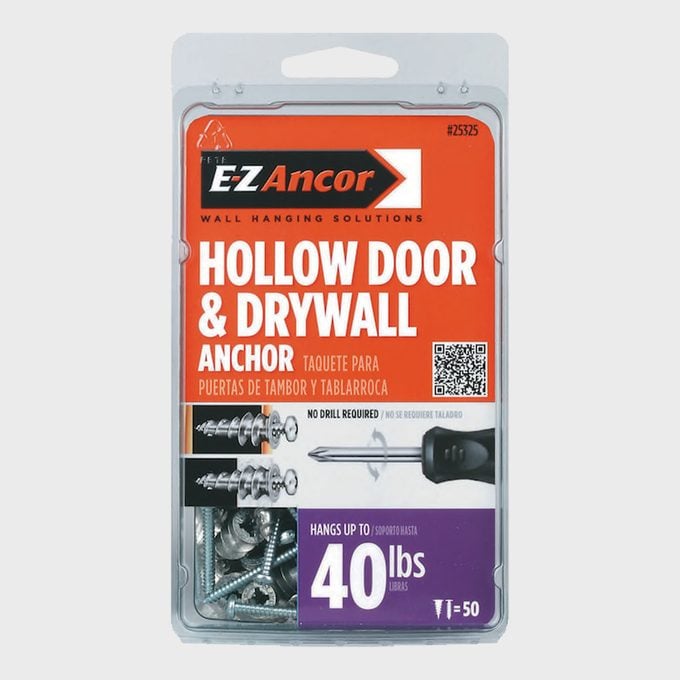
Cocky-drilling anchors are but like they sound: An anchor with a drill tip, designed to be installed with a simple screwdriver. Behind the drill tip, these anchors have wide screw fins to get a good grip on the drywall.
They're available in plastic or metal. Plastic is less expensive, while steel or zinc anchors can sit tight in a stud as well as a hollow wall. Both types are extremely like shooting fish in a barrel to install and remove. They do make a bigger hole than slim expansion anchors, and don't take the holding ability of toggle bolts.
A adept case is this 50-pack from E-Z Anchor, with a three-eighths inch bore and a xl lb. holding capacity.
Read the Packaging
The weight restrictions listed on drywall ballast packaging will be based on a certain wall thickness. If you're not sure, assume your walls are one-half-inch thick. Virtually chiefly, do non use any drywall anchor in a ceiling unless it'due south specifically rated for that application.
Anchors mounted into a wall can utilize the lesser lip of the hole for back up, while ceiling mounts rely solely on their distributed weight. And then expansion anchors accept almost no holding power in a ceiling.
Pull-toggles are often rated for ceiling applications, but read the packaging carefully. While most walls are covered with one-half-inch drywall, many residential ceilings use one-quarter-inch drywall, which has a lower load tolerance. Exist sure to err on the side of caution when hanging anything from the ceiling.
How To Use Drywall Anchors
Installing a drywall anchor is relatively easy.
- Drill the hole. For self-drilling anchors, use a screwdriver. For other types use a drill bit of the size recommended on the packaging.
- Set the anchor. Depending on the type, this may hateful screwing it flush (self-drilling), pulling the toggle tight (pull-toggle) or tapping information technology lightly with a hammer (expansion anchor).
- Set the screw/fastener. With the anchor gear up in the wall, you're fix to place your fastener. Note that toggle-bolt anchors need to be assembled through the item you lot're hanging before the anchor is set.
Drywall Anchors Purchasing and Cost
Drywall anchors are available from many retailers. Costs vary. Here are some of the most common places to detect them.
- Online. You should be able to find whatever y'all demand.
- Price: Mid-range. You may pay a premium for a small pack. Skip the shipping costs by ordering online and picking up at a local shop.
- Local hardware store. Neighborhood hardware stores usually take a wide selection of dependable anchors.
- Cost: Affordable. Most hardware stores can purchase enough fasteners and anchors to get bulk pricing, and are competitive with any other retail source.
- Big box stores. National chains like Lowe's and The Home Depot offering a wide pick of drywall anchors, and fifty-fifty sell assorted kits that permit you go on multiple sizes and styles on paw. These kits are a great improver to your DIY tools and materials collection, especially if you're a new homeowner.
- Cost: Affordable. The big box stores offering amazing choice and prices for hardware, like drywall anchors.
- General household stores. Grocery stores and retail outlets that focus on abode goods and supplies will often carry a limited range of drywall anchors.
- Price: High. But they're a bully place to grab some simple anchors while getting your other shopping done.
- Included with fixtures. Many items, from towel racks to goggle box mounts, come with multiple screws and anchors. The manufacturers want you to mount their goods whether you're hanging it on drywall, into a stud or on a brick wall. Y'all won't use them all, so rather than throw away the extras, add them to your anchor collection. Eventually y'all'll accept enough for any job. You'll be surprised how often yous'll delve into this collection.
- Cost: Gratuitous!
Source: https://www.familyhandyman.com/article/drywall-anchors/
0 Response to "Drywall Anchors: What To Know Before You Buy | The Family Handyman"
Post a Comment