San Mateo Ca Real Estate Market Review 2018
30+ Years of Housing Market Cycles Recessions, Recoveries, Booms, Bubbles
in the San Francisco Bay Area
& Adjustments (Sometimes Crashes)
past Patrick Carlisle, Compass chief market annotator, SF Bay Expanse
Below is a look at the by 30+ years of San Francisco Bay Area real estate boom and bust cycles. Financial-market place cycles have been around for hundreds of years, from the Dutch tulip mania of the 1600'due south through today's speculative frenzy in digital-currencies. While future cycles volition vary in their details, the causes, effects and trend lines are frequently quite similar. Looking at cycles gives united states of america more context to how the marketplace works over time and where it may be going -- much more than dwelling in the immediacy of the present with excitable pronouncements of "The market's crashing and won't recover in our lifetimes!" or "The market's crazy hot and the simply identify it can become is up!"
Note: About of these charts generally apply to higher-priced Bay Area housing markets, such equally those found in much of San Francisco, Marin, Cardinal Contra Costa (Lamorinda & Diablo Valley) and San Mateo Counties. (Different market price segments had bubbles, crashes - or adjustments - and recoveries of differing magnitudes in the last cycle, which is addressed at the end of this report.)
Regardless of how recent cycles have played out, it is vital to empathize how extremely difficult information technology is to predict when different parts of a bicycle will begin or terminate. Case in indicate: In 2012, a Nobel-Prize-winning economist stated that home prices might not recover "in our lifetimes," when in fact, the recovery had already (but) begun. In late 2015, when financial markets entered into a flow of nasty volatility, IPO activity stopped in its tracks, and high-tech hiring slowed, a well-respected Berkeley economist prophesied there would soon exist "claret in the streets" of San Francisco - yet the market recovered and grew significantly more than heated through mid-2018. Blast times tin can go on much longer than expected, or get 2d winds. Even when the fiscal markets enter a menstruum of "irrational exuberance," that period can go along much longer than seems possible, with huge jumps in abode and/or stock values.On the other hand, negative shocks can announced with startling suddenness, triggered by unexpected economic, political or even ecological events that hammer confidence, apace spinning optimism into fear. (The world has become staggeringly complex and interconnected, with a huge number of spinning plates at any given time.) This can atomic number 82 to other market dominoes falling, the reversal of positive trends in growth, investment and employment, which may so airship into a menstruation of pass up, recession, stagnation. These negative adjustments tin exist of varying scale. They tin be in the nature of an extended but temporary period of high financial-market volatility and investor caution, such as caused past the Chinese stock market drib/oil price crash/Brexit vote in mid-2015 through mid-2016. It can exist a definitive, era-defining financial-market crash or speculative bubble bursting, such equally in 2008. Or the down cycle can occur gradually, similar a ho-hum leak in an over-pumped football game.
As of early March, information technology is non yet known which category the coronavirus - a true "black swan" issue - will fall into, whether a dramatic, but relatively temporary catamenia high volatility, or the trigger for a plunge into an extended market recession in stock and housing values.
Going back thousands or fifty-fifty tens of thousands of years, human being beings accept tried to predict the future, and whether using priests, oracles, astrologers, pundits, economists, analysts or "experts" of every stripe - and currently having their "authoritative" forecasts headlined every twenty-four hours in the media - nosotros show no bent as a species for having the ability to do so with any accuracy. Nosotros tin't fifty-fifty remember the mistakes of the recent by - which is i reason why we don't seem to be able to escape cycles - much less foretell what's going to happen tomorrow.
Conviction plays an enormous office in financial and real estate markets, and in every period of irrational exuberance, there are many who vociferously argue that the exuberance is NOT irrational. Unfortunately, it tin be very challenging to make up one's mind the signal at which rational confidence shifts into irrational exuberance, but when irrational exuberance abruptly shifts into fear, a stampede for the exits tin can follow - as an old English maxim puts information technology: "They run all away, and cry, 'the devil take the hindmost'." In retrospect, the duration of periods of irrational exuberance, when market place gains often accelerate into the stratosphere, seems utterly incomprehensible. Such are the pleasures of hindsight. All the major recessions in the Bay Area in contempo decades have been tied to national or international economical crises, which can take a wide variety of forms. Absent-minded an enormous natural disaster, information technology is unlikely that a major, negative market adjustment (or "crash") would occur due simply to local issues. However, local issues tin certainly lead to less dramatic market adjustments, or exacerbate a downturn caused past a macro-economic upshot. The SF earthquake of 1989 intensified the national recession that began at that time; our greater exposure to dotcom start-ups did the same with the national dotcom-bubble/Nasdaq crash.Up, Down, Flat, Upwards, Down, Flat...(Repeat)
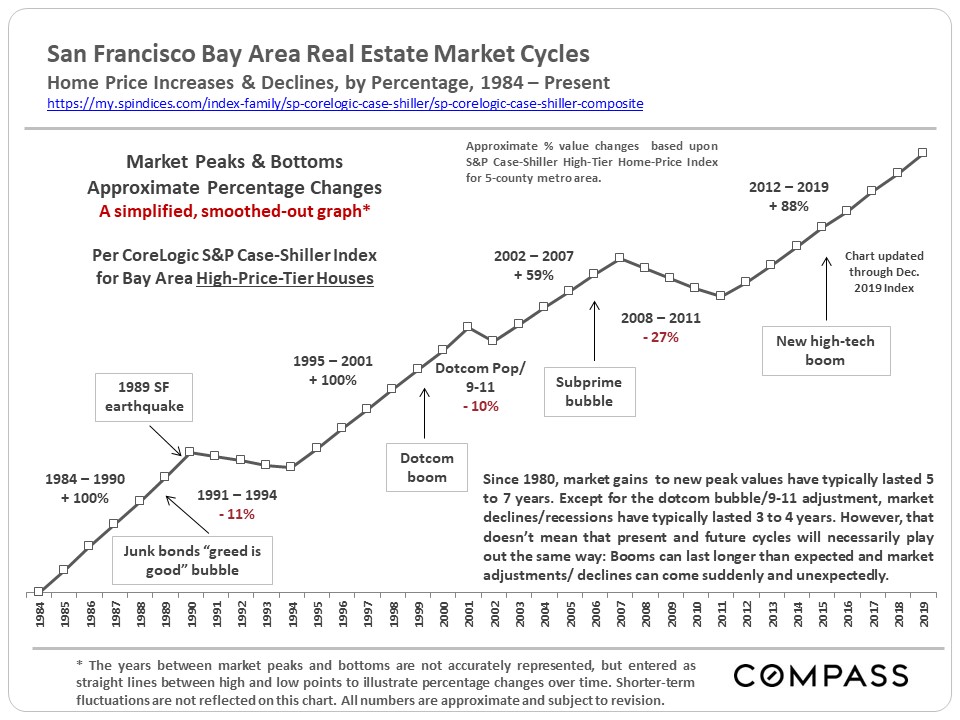
Smoothing out the bumps - temporary periods of volatility with their ups and downs - delivers the simplified overview higher up for the by xxx years. Any the phase of the cycle, upwards or down, while it is going on people think information technology will concluding forever. Going up, "The globe is different now, the rules have changed, and there's no reason why the up-bike can't proceed indefinitely." Well, information technology turns out that the rules do indeed withal apply and upwardly-cycles ever end. And then when the market turns and goes down: "Homeownership has always been a terrible investment and the marketplace probably won't recover for decades" (or even "in our lifetimes" as the Nobel-Prize-winning economist said in 2012). But the economy mends, the population grows, people start families, inflation builds up over the years, and repressed demand of those who desire to ain their own homes builds upwards. In the early on eighties, mid-nineties and in 2012, afterwards about 4 years of a recessionary housing market, this repressed demand jumped back in (or "explodes" might exist a good description) and prices started to rise again. (The dotcom bubble adjustment caused a hiccup, only no lasting recession in home values.)
The nature of cycles is to continue turning.
All bubbles are ultimately based on irrational exuberance, runaway greed, criminal behavior or, non uncommonly, all three mashed together. Whether exemplified by junk bonds, stock marketplace hysteria, gorging on untenable levels of debt, a corporate ponzi-scheme mentality, an abandonment of reasonable risk cess, and/or incomprehensible or dishonest financial technology, the bubble is relentlessly pumped bigger and tighter - awaiting the trigger result that will play the role of pivot. And since human beings announced utterly unable or unwilling to larn the lessons of by cycles, it is kind of like the movie "Groundhog Solar day," except that in the picture show at least, Neb Murray actually grew wiser over time. The 2008 crash was truly abnormal in its scale, and much greater than other downturns going dorsum to the Great Depression. The 2005-2007 bubble was fueled past home ownership and refinancing with unaffordable amounts of debt on a staggering level, promoted past predatory lending practices, promises of endless appreciation, and an abysmal decline in underwriting standards - and so eagerly facilitated by smug, rapacious, Wall Street flimflammery and cocky-abasing credit ratings agencies. Millions came to ain homes they could never afford to pay for and the rot was distributed throughout the fiscal system. The marketplace adjustments of the early 1990's and early-2000's saw declines in Bay Surface area home values in the range of 10% to 11%, which were bad enough, but zip compared to the terrible 2008 - 2011 declines of xx% to 60%. This is of import context when contemplating the next aligning: It doesn't have to be a devastating crash. It can be more than like some air being permit out of an over-pressurized tire instead of a blowout on the highway at loftier speed. It depends on many different factors. Link to new report, updated for pandemic: Bay Expanse Market Cycles since 1990, by Canton 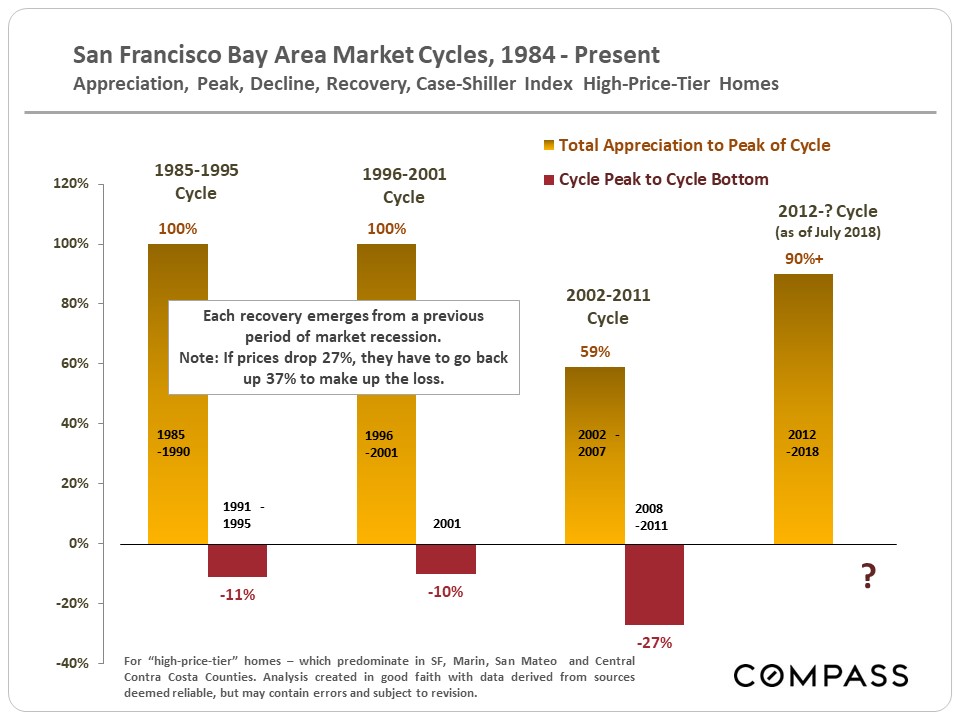
Over the past 30+ years, the menstruum between a recovery beginning and a bubble popping (or a lesser aligning occurring) has run 5 to 7 years. We are currently about 5 years into the electric current recovery, which started in early 2012 (in San Francisco; later in outlying Bay Area counties). Periods of market recession/doldrums following the popping of a chimera have typically lasted almost 3-4 years. (The 2001 dotcom bubble/ 9-11 crisis drop being the exception.) More often than not speaking, within about ii-three years of a new recovery commencing, previous peak values (i.e. those at the superlative of the previous bubble) are re-attained -- among other reasons, there is the recapture of inflation during the doldrums years. In this current recovery, those homes hitting hardest past the subprime loan crisis -- typically housing at the lowest end of the price scale in the less affluent neighborhoods, which experienced by far the biggest bubble and biggest crash -- are appreciating quickly now, and simply commencement to re-attain previous peak values. However, communities with higher priced homes -- such as in San Francisco, Marin, San Mateo and Fundamental Contra Costa Counties (Diablo Valley & Lamorinda) -- take surged well past their previous peaks.
This does not hateful that these recently recurring time periods necessarily reflect some natural law in housing market cycles, or that they can be relied upon to predict the future. Real estate markets can be affected by a bewildering number of local, national and international economic, political and even natural-result factors that are exceedingly hard or fifty-fifty impossible to predict with any accuracy.
As long as one doesn't take to sell during a down cycle, Bay Area homeownership has well-nigh ever been a adept or even spectacular investment (though admittedly if one does have to sell at the bottom of the marketplace, the results tin can exist very painful). This is due to the ability to finance 1'southward buy (and refinance when rates drop), revenue enhancement benefits, the gradual pay-off of the mortgage (the "forced savings" effect), inflation and long-term appreciation trends. The best way to overcome cycles is to buy a home for the longer term, i whose monthly toll is readily affordable for yous, ideally using a long-term, fixed-rate loan.
(After Recession) Boom, Reject, Doldrums
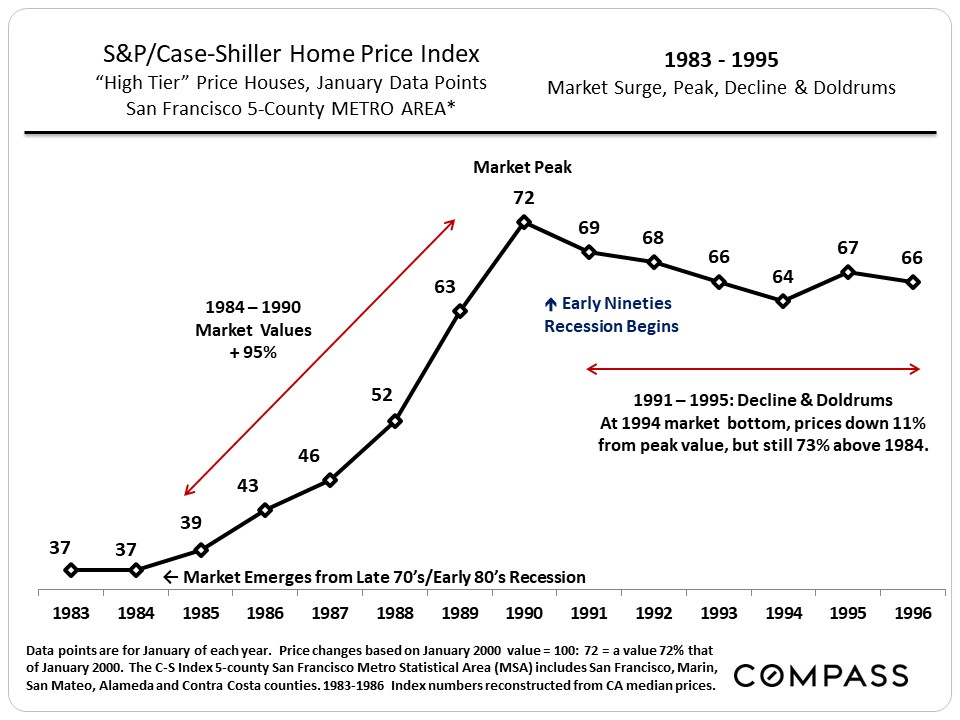
In the higher up chart, the country is just coming out of the late seventies, early on eighties recession featuring terrible inflation, stagnant economy ("stagflation") and incredibly high interest rates (hitting 18%). Every bit the economy recovered, the housing market place started to capeesh and this surge in values began to advance deeper into the decade. Over 6 years, the market appreciated about 100%. Finally, the late eighties "Greed is good!" version of irrational exuberance -- junk bonds, stock market swindles, the Savings & Loan implosion, as well as the late 1989 convulsion here in the Bay Area -- ended the party.
Recession arrived, domicile prices sank about 11%, sales activity plunged and the marketplace stayed basically flat for 4 to v years. Still, fifty-fifty after the reject, home values were lxx% higher than when the boom began in 1984.
(After Recession) Boom, Bubble, Crash, Doldrums, Recovery
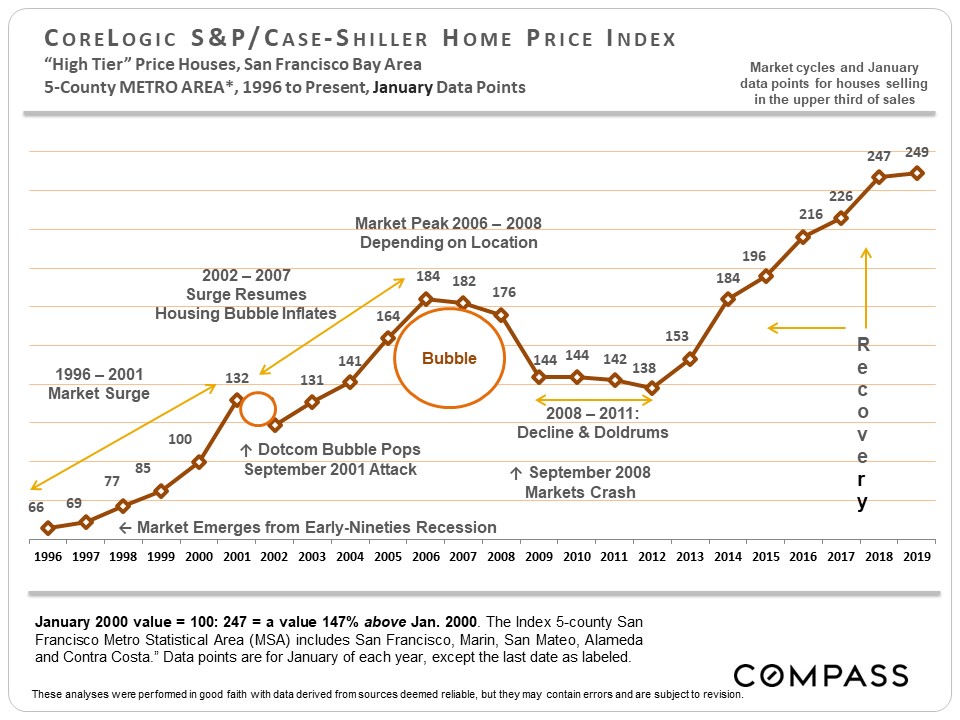
This next wheel looks similar but elongated. In 1996, later years of recession, the marketplace of a sudden took off and continued to accelerate til 2001. The dotcom bubble pop and September 2001 attacks created a market hiccup (a short-term x% decline, but only for high-price tier houses, and for condos), but then the subprime and refinance insanity, degraded loan underwriting standards, mortgage securitization, and claims that real estate values never decline, super-charged a housing bubble. Overall, from 1996 to 2006/2008, the market went through an astounding menstruation of appreciation. (Different areas hit peak values at times from 2006 to early 2008.) The air started to go out of some markets in 2006-2007, and in September 2008 came the fiscal markets crash.
Across the country, home values typically fell 20% to 60%, peak to bottom, depending on the area and how badly it was affected by foreclosures -- most of San Francisco, with relatively few foreclosures, got off comparatively lightly with declines in the xv% to 25% range. The least affluent areas got hammered hardest past distressed sales and price declines; the almost affluent were normally least affected. Then the market place stayed flat for about iv years, albeit with a few short-term fluctuations. Tied to a chop-chop recovering economic system, supply and need dynamics began to significantly change in San Francisco in mid-2011, leading to the market recovery of 2012.
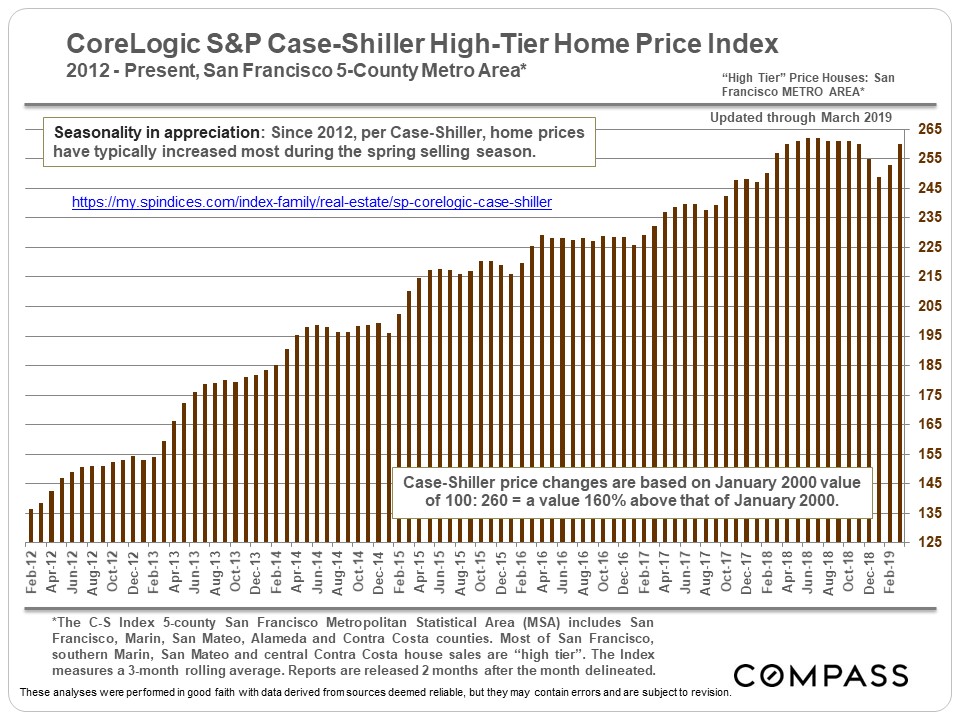
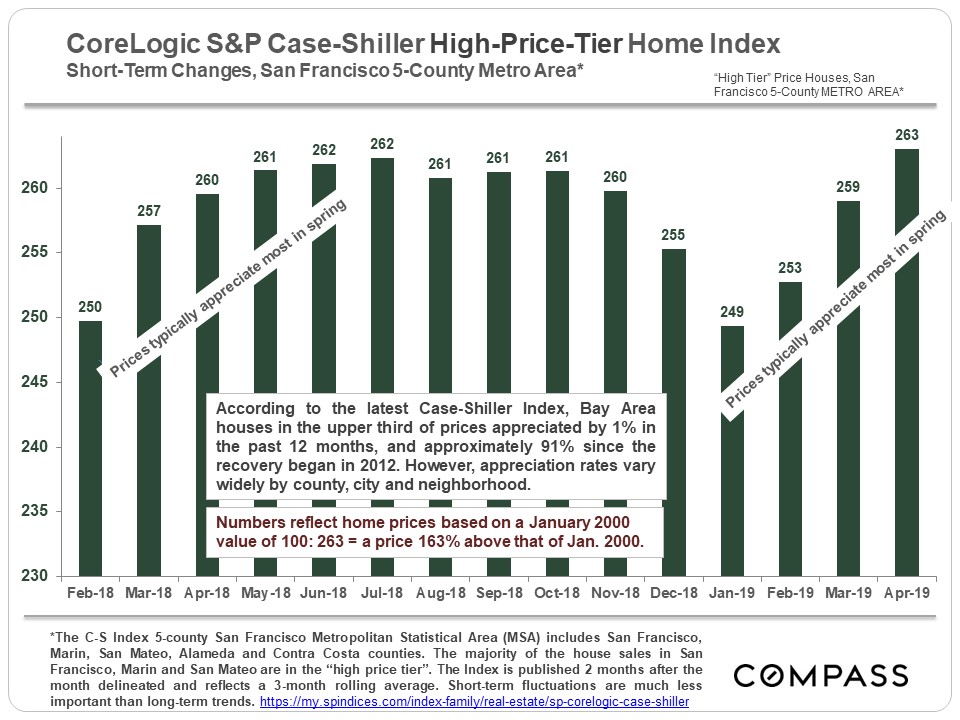
 The Panorama: From the late 1980's to Present
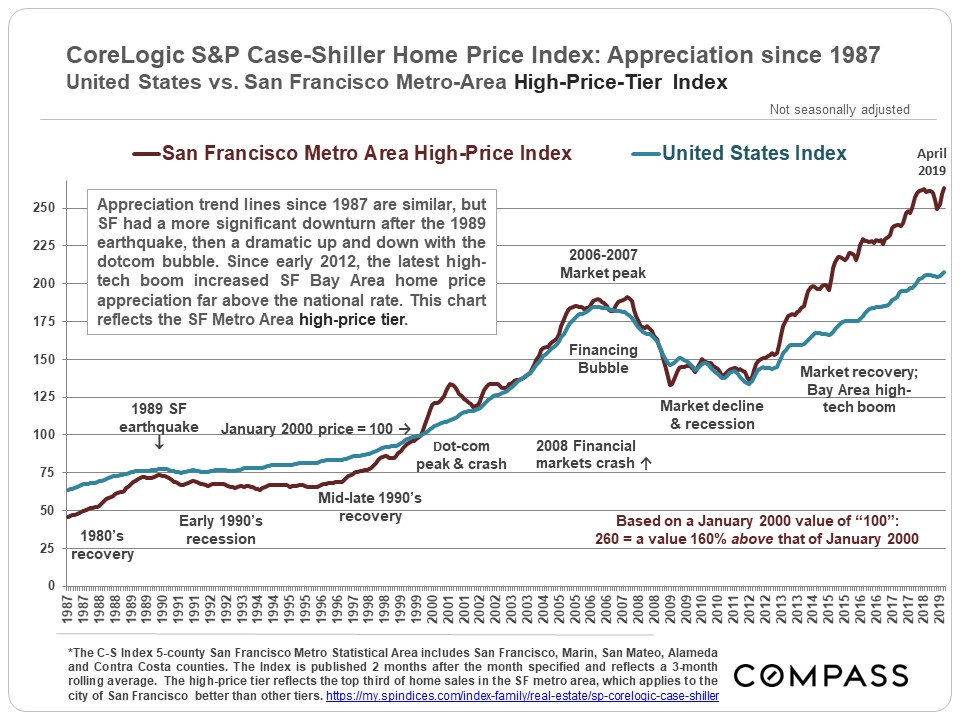
 S&P Example-Shiller Index, 5-County SF Metro Area
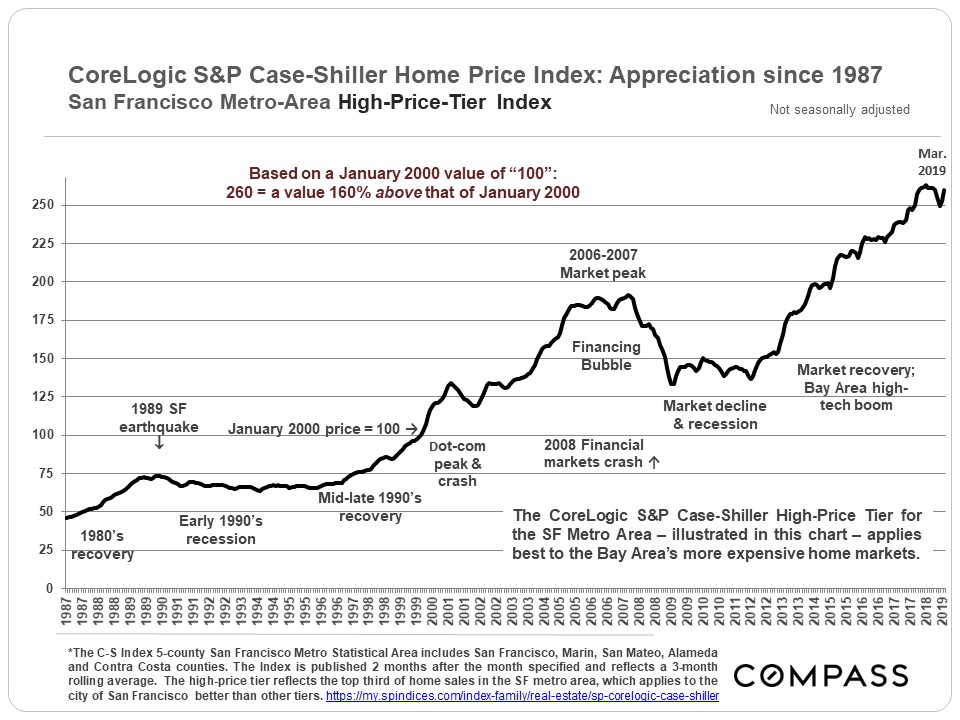
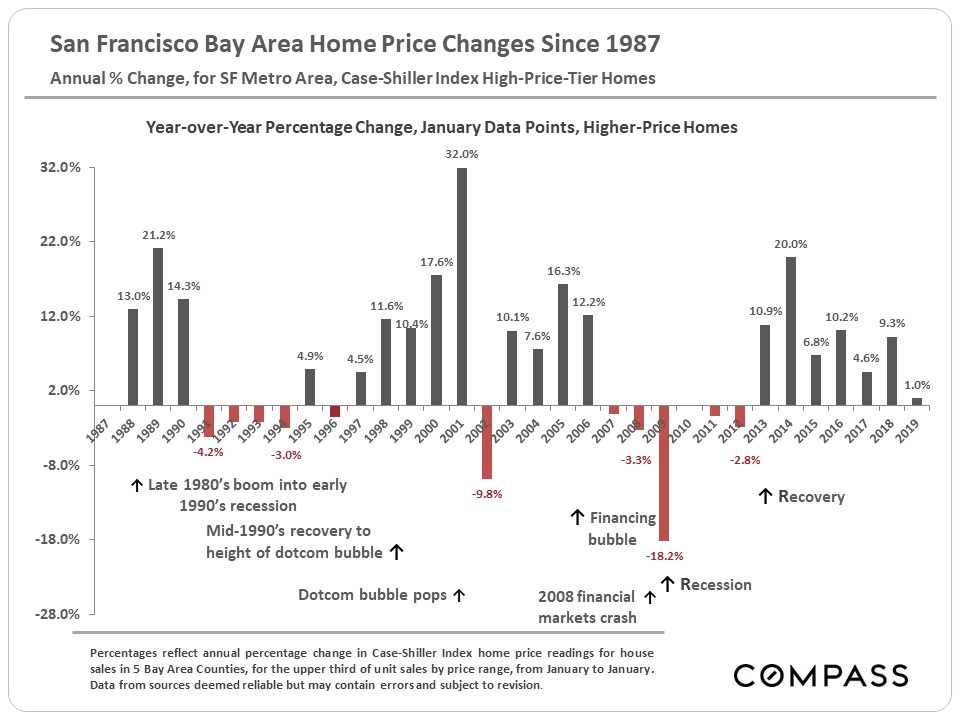
Home Price Appreciation Trends since 1987
******************************
San Francisco Median Sales Price Appreciation 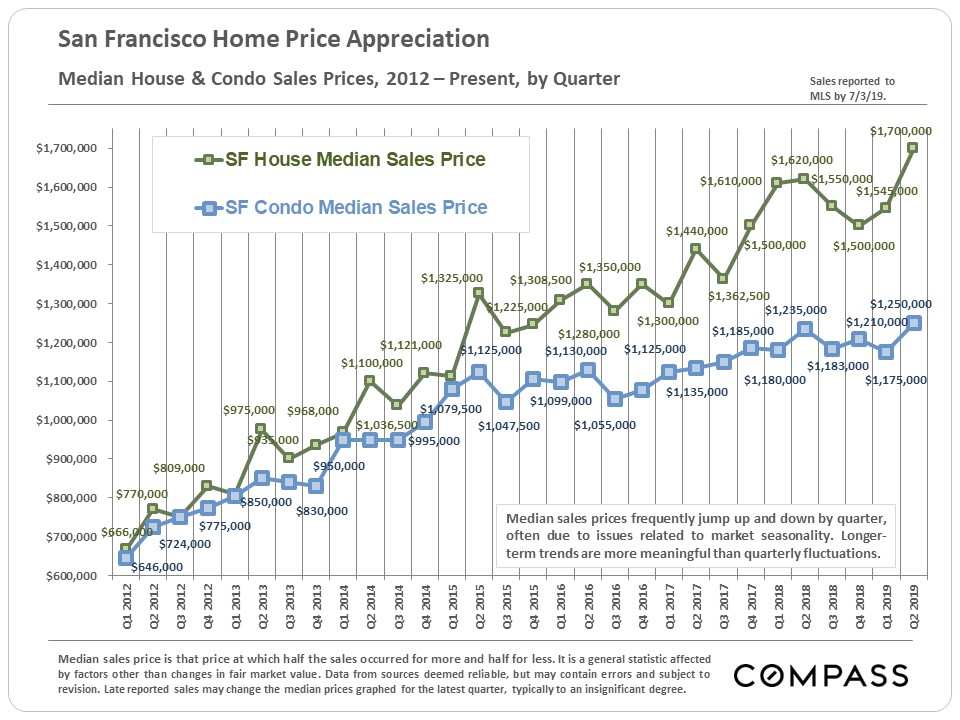
In 2011, San Francisco began to show signs of perking up. An improving economy, soaring rents, low interest rates and growing buyer need coupled with a depression inventory of listings began to put upward pressure on prices. In 2012, every bit in 1996, the market place abruptly grew frenzied with competitive bidding. The city'south flush neighborhoods led the recovery, and those considered particularly desirable by newly wealthy, loftier-tech workers showed the largest gains. Still, virtually the entire city shortly followed to experience similar rapid price appreciation.
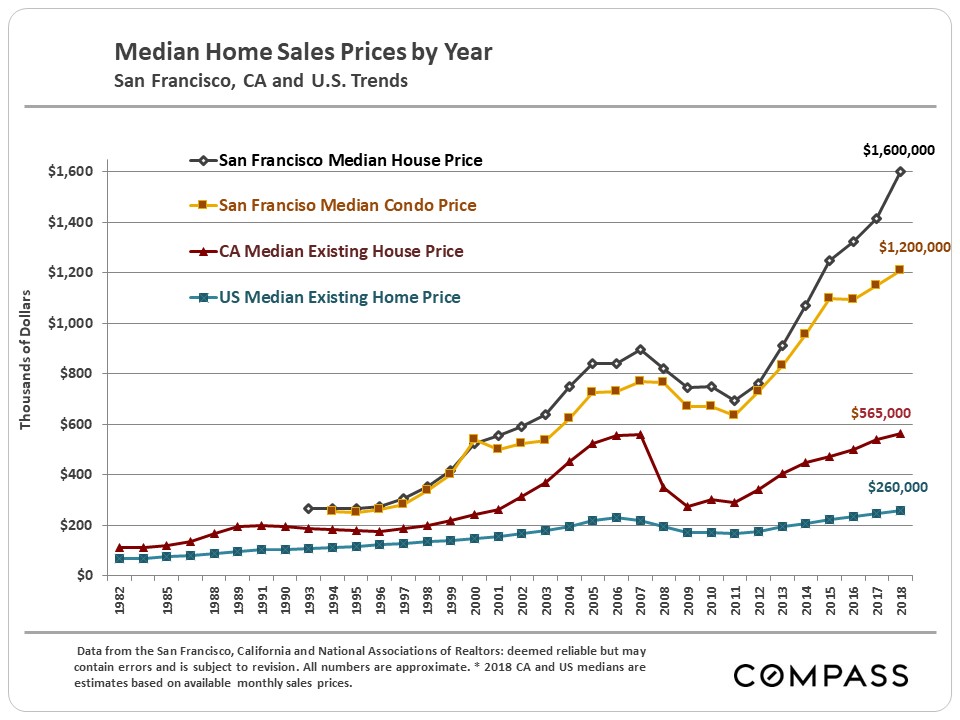
San Francisco median home sales prices increased dramatically in 2012, 2013, 2014, and and then again in the first half of 2015. In 2016, the SF market clearly cooled compared to the competitive frenzies of previous spring selling seasons, simply in 2017 so far, in early 2018, the market came roaring back again for possibly its hottest market since 2000. In summer 2018, things cooled down significantly through the end of the year - this coincided with extremely volatile stock markets and sharply rising interest rates. Then, in 2019, stock markets soared over again to hitting new peaks, involvement rates dropped to hit multi-year lows, and local high-tech unicorns went IPO in quantity: The jump 2019 market rebounded dramatically, and in Q2 2019, median home sales prices surpassed the highs hit in 2018.
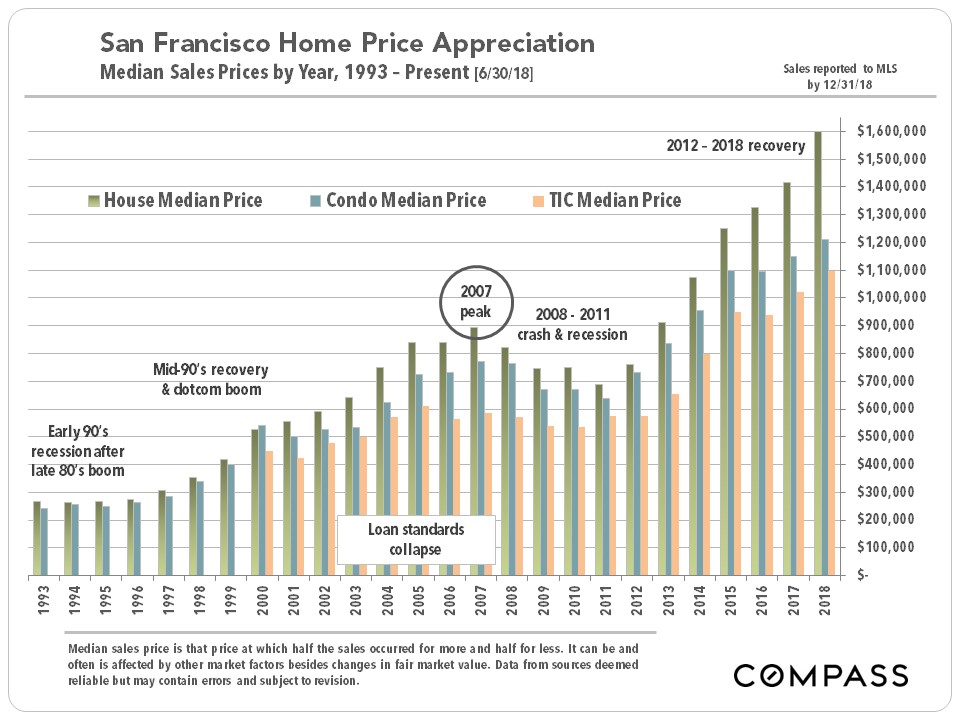
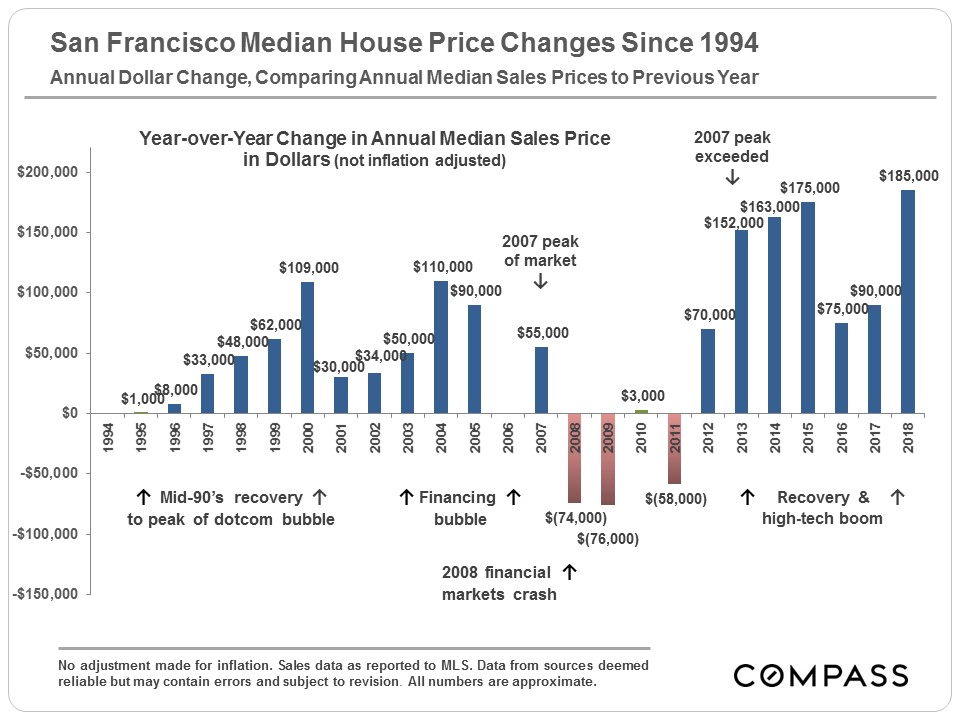
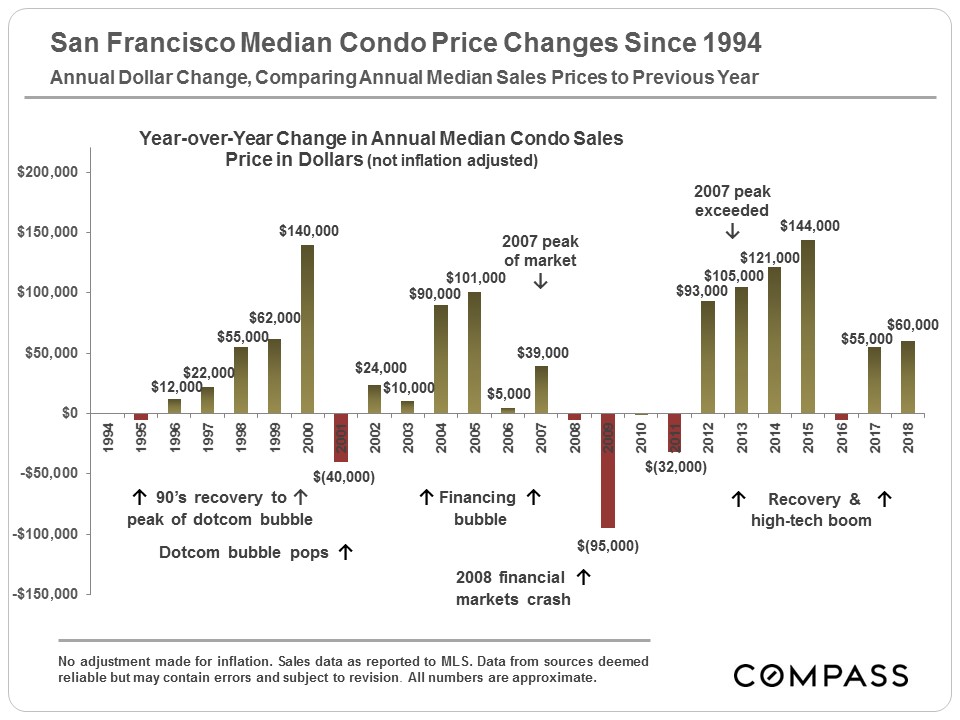
Median Price Appreciation
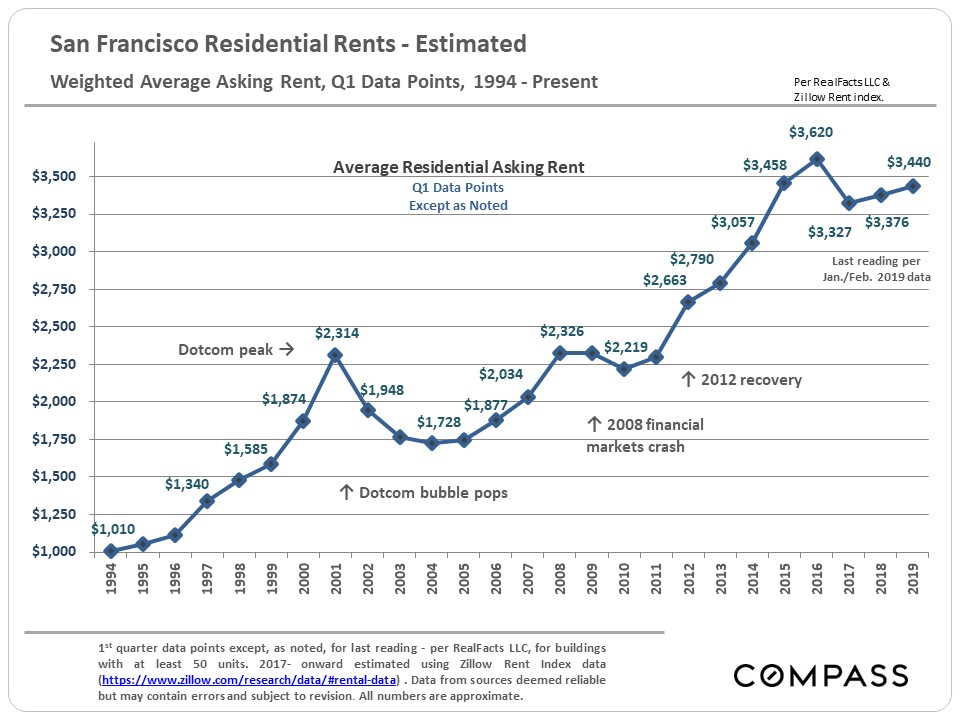
Information technology's interesting to notation that SF rents really dropped much further after the dotcom bubble flare-up than after the 2008 financial markets crash, though the latter was a much more than destructive economic result. It suggests that local rents may be more affected by the elementary ebb and menstruum of high-tech hiring and employment than by other macro-economical issues, such as stock market place changes. If one loses one's task and the likelihood of finding another in the area plunges, it may exist an firsthand imperative to motility to a less expensive rental area (pressuring rents lower); if i's net worth plunges with a stock market crash, one may no longer afford to buy a home (pressuring dwelling house prices lower). This is an oversimplification, merely may all the same go some ways to explaining the unlike calibration of reaction by purchase and rental markets to different macro-economic events.
Afterward peaking in 2015, the SF rental market definitely cooled in 2016, with supply increasing significantly with new construction, demand softening (as the high-tech smash temporarily cooled), and rents beginning to decline, peculiarly at the loftier end. SF asking rents dropped around 8 - 10% from their peaks in 2015. In 2018, some signs of recovery showed upwards.
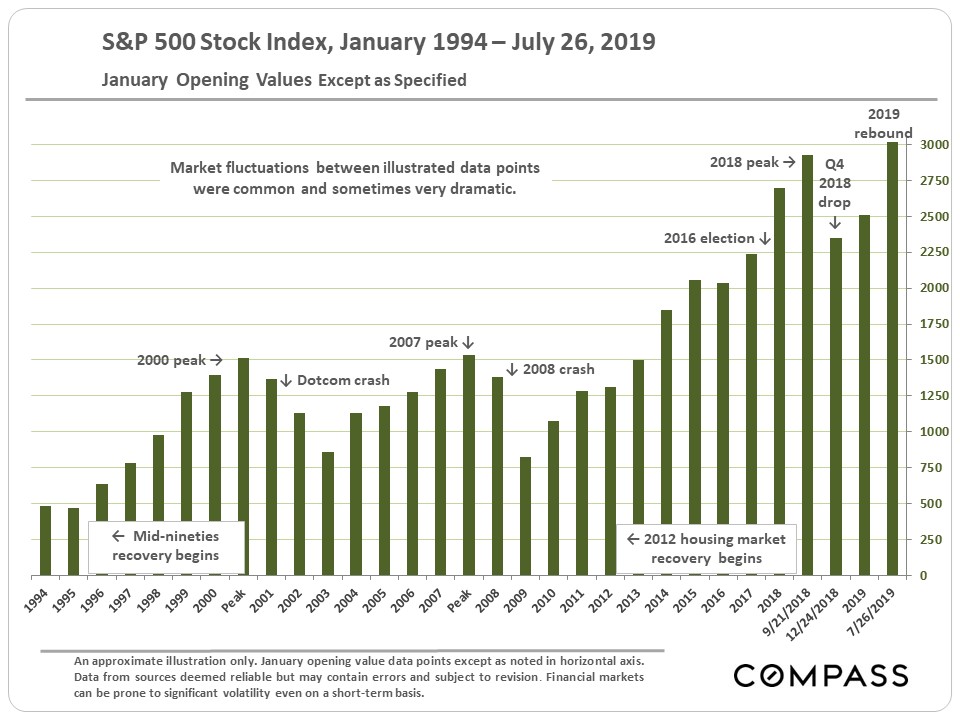
Stock Market (Southward&P 500 Alphabetize)
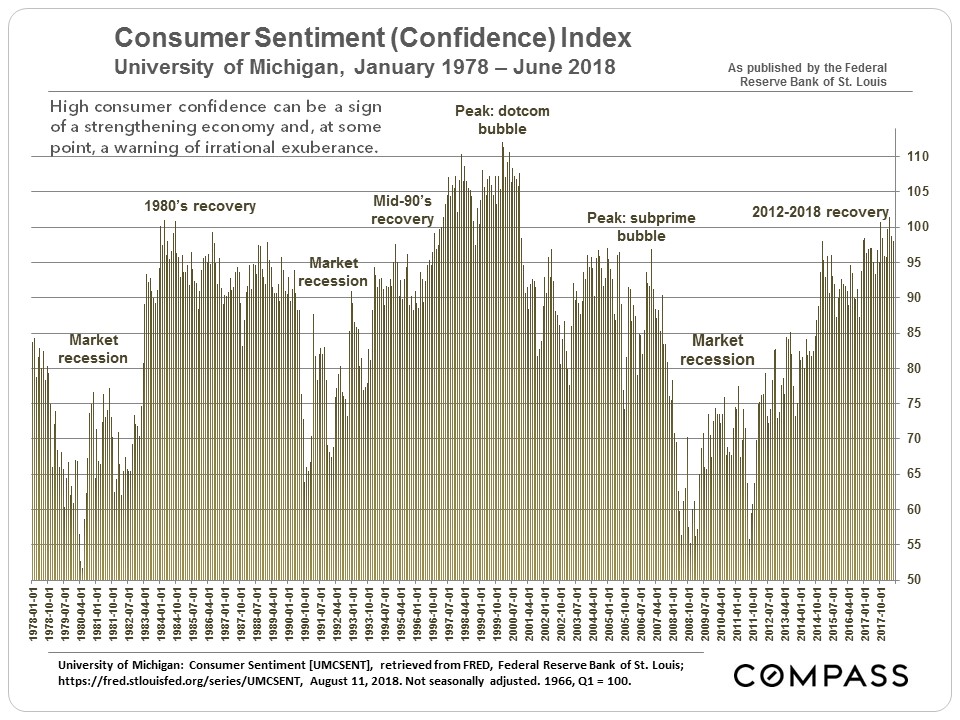
Consumer Confidence
******************************
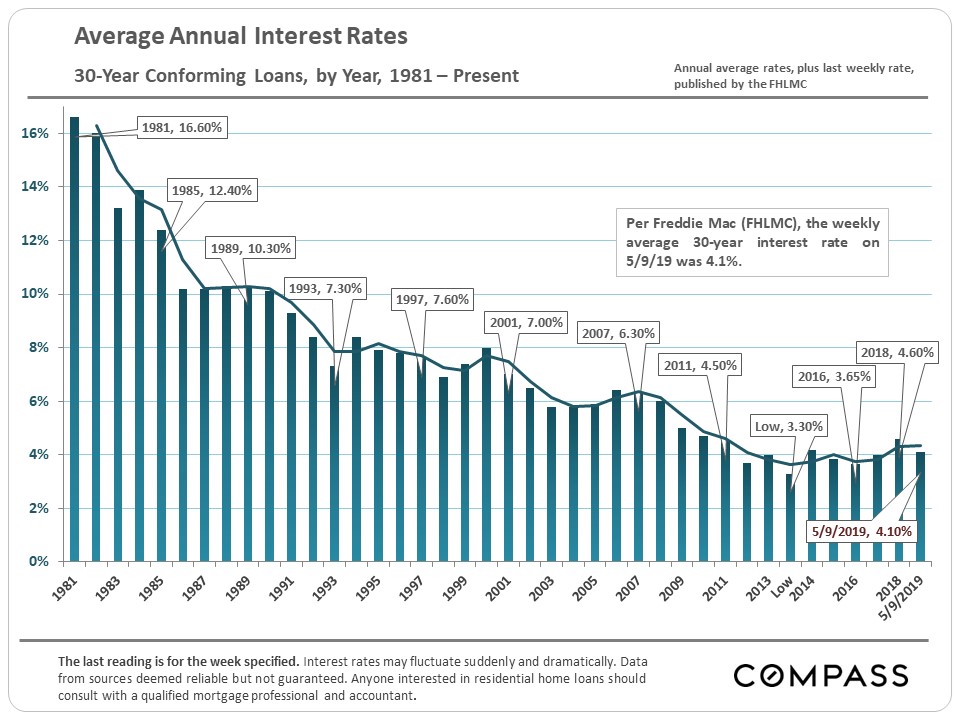
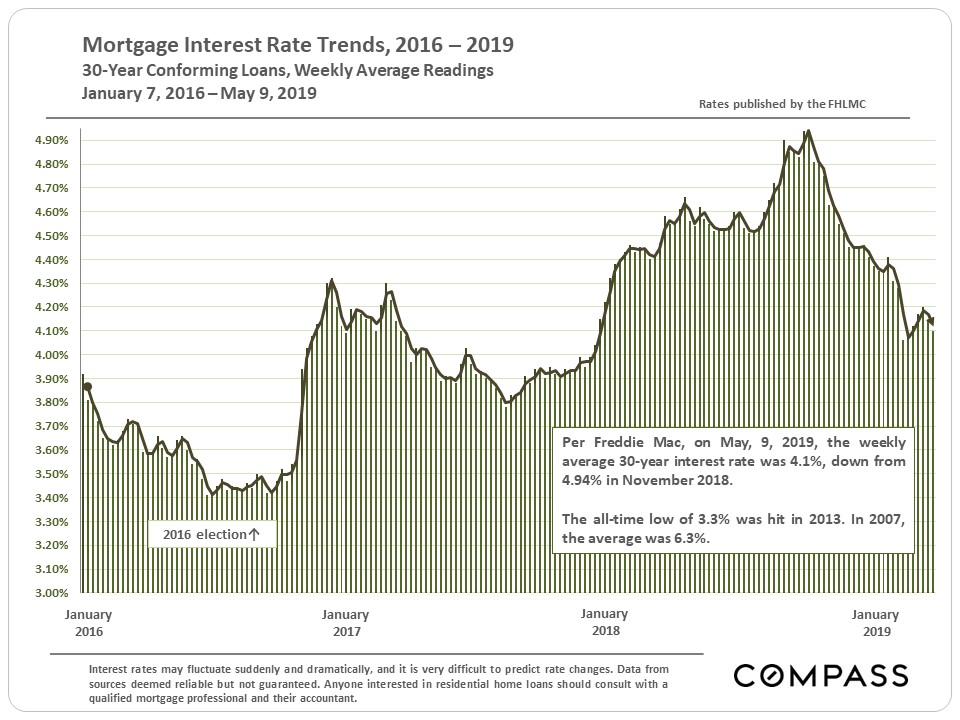
Mortgage Involvement Rates since 1981It's much harder to decipher any cycles in thirty-year mortgage rates. Rates remain very low by any historical measure, but have risen since the 2016 election. Interest rates play a huge part in the ongoing cost of homeownership (affordability) and the existent manor market. The substantial decline in involvement rates since 2007 has in effect subsidized much of the toll increases that have occurred since 2011.
******************************
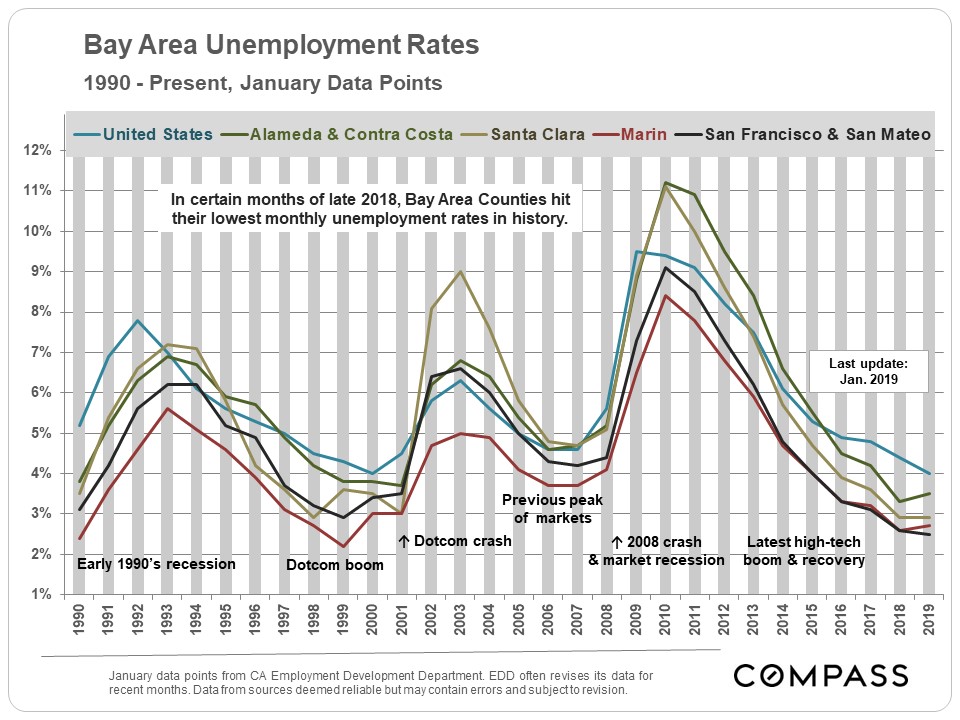
Employment Trends 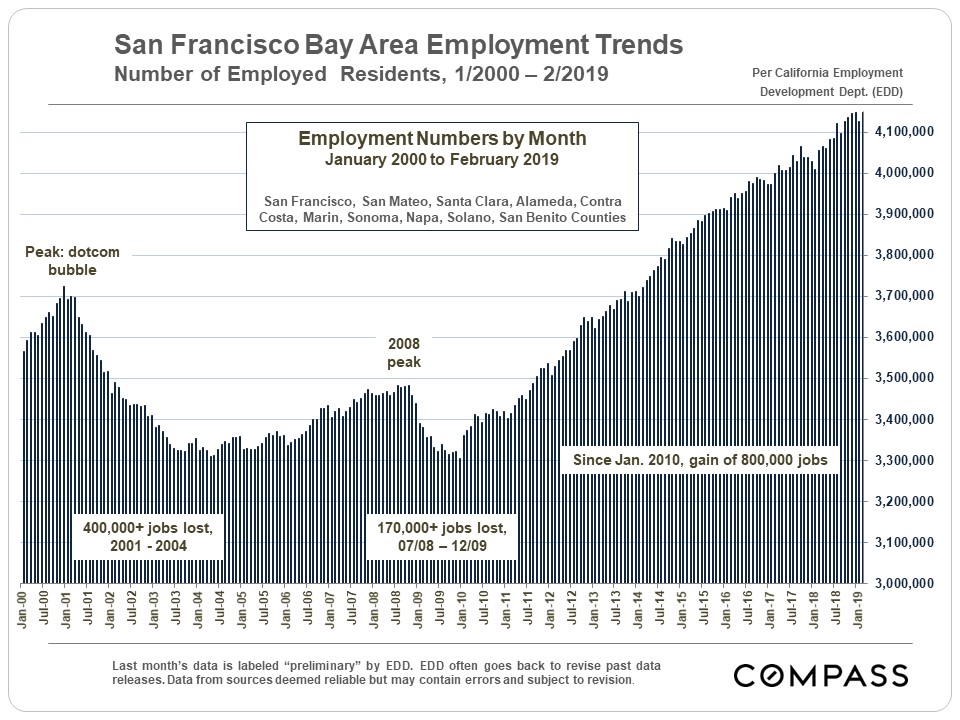
******************************
Housing Affordability Alphabetize (HAI) Cycles, 1991 - Presentfor San Francisco & Bay Area, per CA Association of Realtors
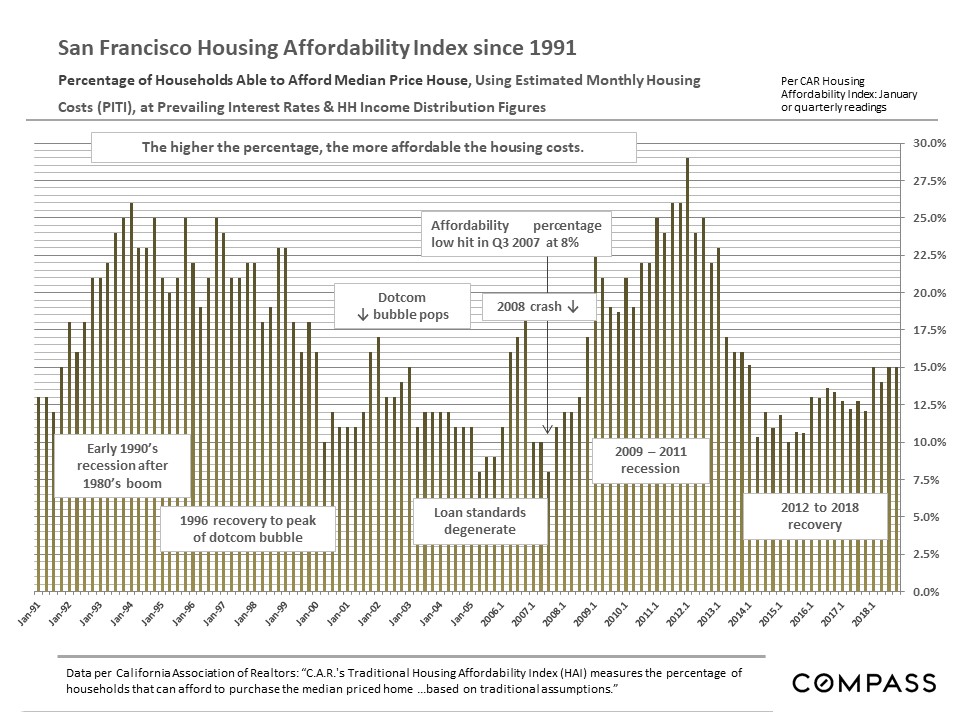
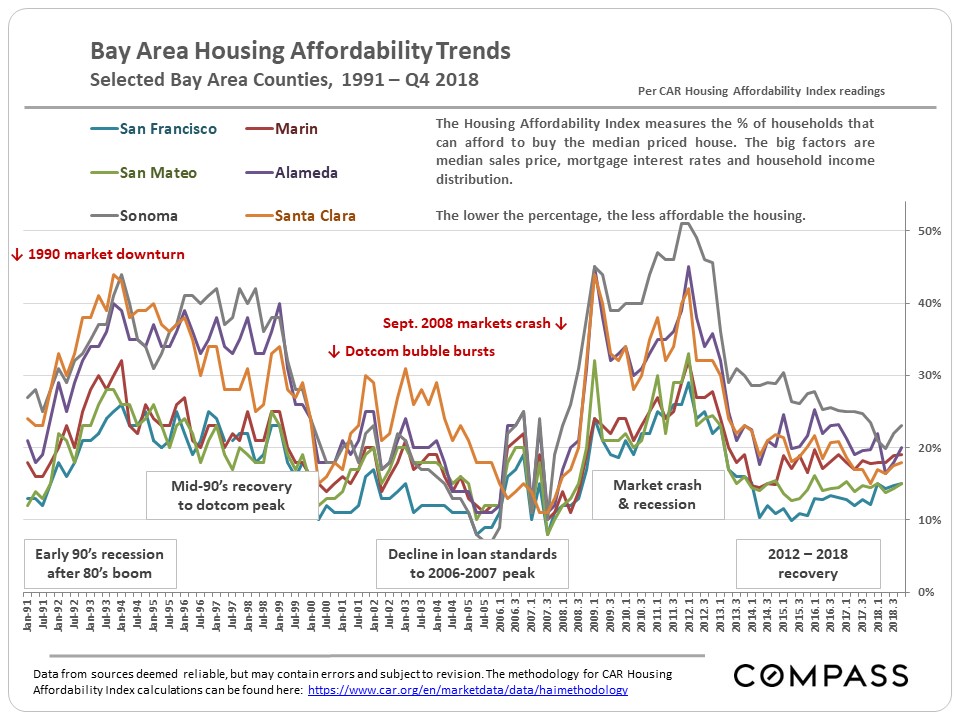
The 2008 San Francisco Bay Area real estate crash was non caused only by a local affordability crisis: It was triggered by macro-economic events in financial markets which affected existent estate markets across the country. It is important to note that in the past (certainly going dorsum at least l years), major corrections to Bay Surface area home prices did not occur in isolation, but parallel to national economic events (though the 1989 convulsion, which occurred simply before the national recession began, certainly exacerbated the local downturn). Ongoing speculation on local bubbles (and predictions of awful upcoming local crashes) often neglect to remember this.
Still, dwindling affordability is certainly a symptom of overheating, of a marketplace existence pushed perhaps too high. Looking at the charts in a higher place, it is interesting to notation that the markets of all Bay Area counties hit similar and celebrated lows at previous market peaks in 2006-2007, i.e. the pressure that began in the San Francisco market place spread out to pressurize surrounding markets until all the areas bottomed out in affordability. This suggests that i gene or symptom of a correction, is not merely a feverish San Francisco market, but that buyers cannot find affordable options anywhere in the expanse. We are certainly seeing that radiating pressure on home prices occurring at present, starting in San Francisco and San Mateo (Silicon Valley) and surging out to all points of the compass.
Significant increases in mortgage interest rates - equally happened in the second half of 2018 (before and then subsiding over again in 2019) - affect affordability chop-chop and dramatically, equally interest rates forth with, of course, housing prices and household incomes, play the dominant roles in this calculation.
Unlike Bubbles, Crashes & Recoveries
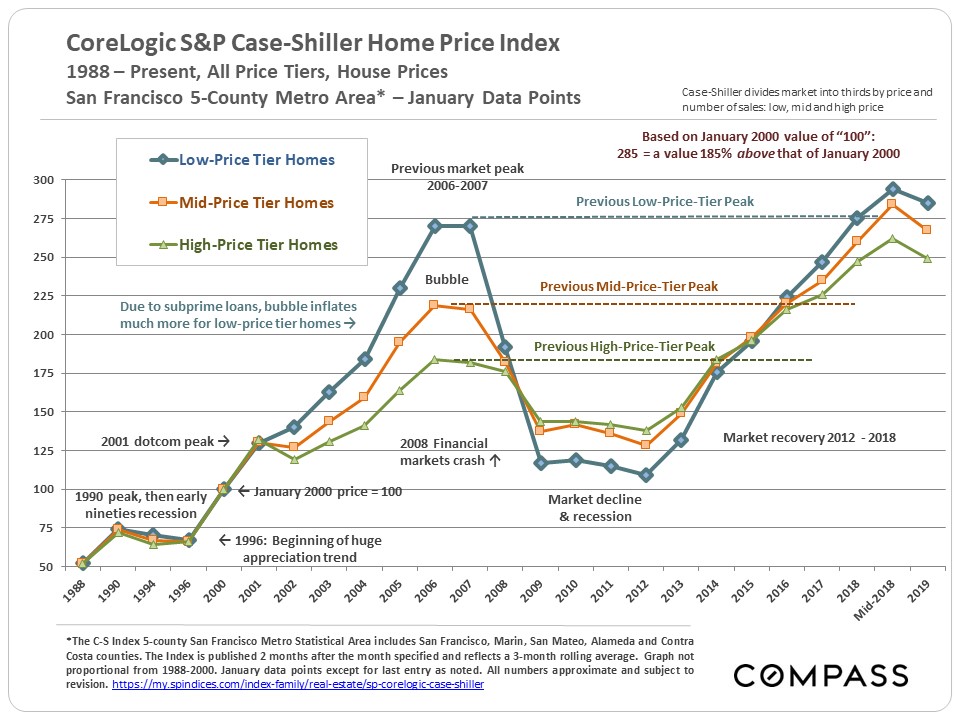
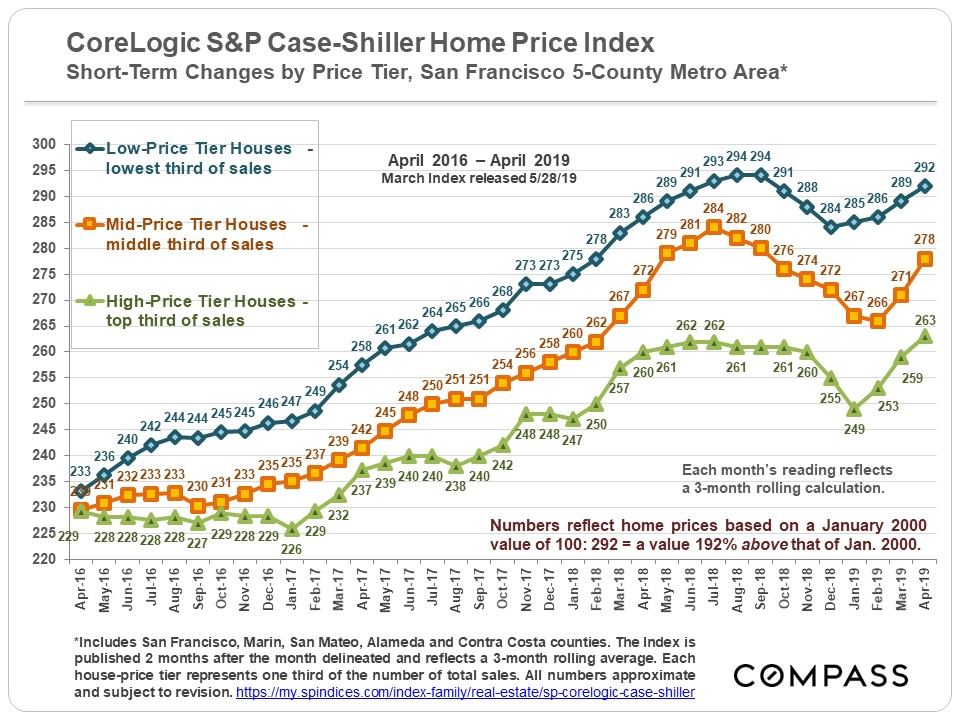
The comparing composite chart dramatically illustrates the radically dissimilar market movements of different Bay Expanse housing price segments since 2000. Further below are updated individual cost charts for each price segment.
Once more, all numbers in the Case-Shiller nautical chart relate to a January 2000 value of 100: A reading of 220 signifies a dwelling house value 120% above that of January 2000. The chart above illustrate how different market segments in the five-county SF metro area had bubbles, crashes and at present recoveries of enormously different magnitudes, generally depending on the affect of subprime lending. The lower the price range, the bigger the bubble and crash. In the city itself, where many of our abode sales would constitute an ultra-high price segment, if Case-Shiller broke it out, many of our neighborhoods have risen to new peak values. Updated C-S charts for each price segment are below.
Since mid-2016, the low-price tier has begun taking the lead in home toll appreciation.
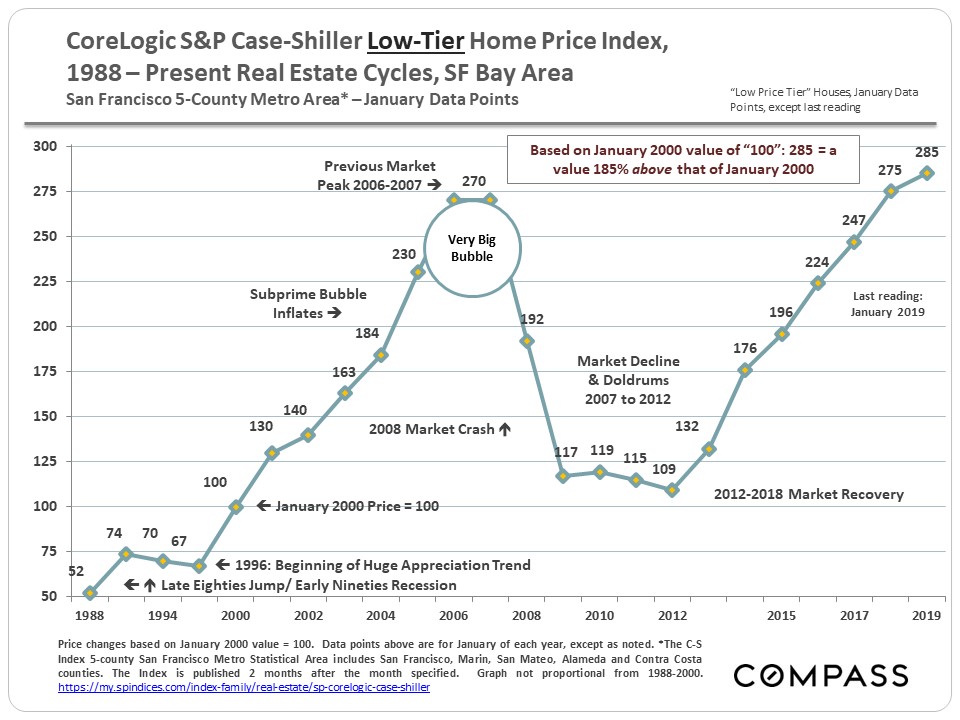
Huge subprime bubble (170% appreciation, 2000 - 2006) & huge crash
(60% turn down, 2008 - 2011). Strong recovery, now slightly above previous acme.
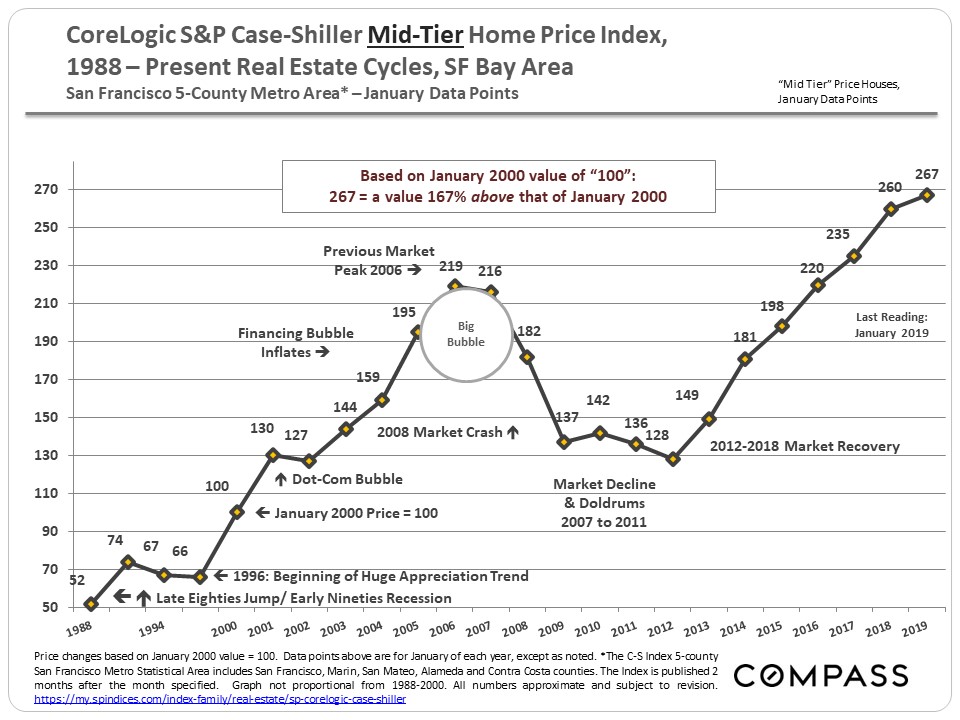
Smaller chimera (119% appreciation, 2000 - 2006) and crash (42% pass up)
than low-cost tier. Potent recovery has put it significantly over its 2006 top.
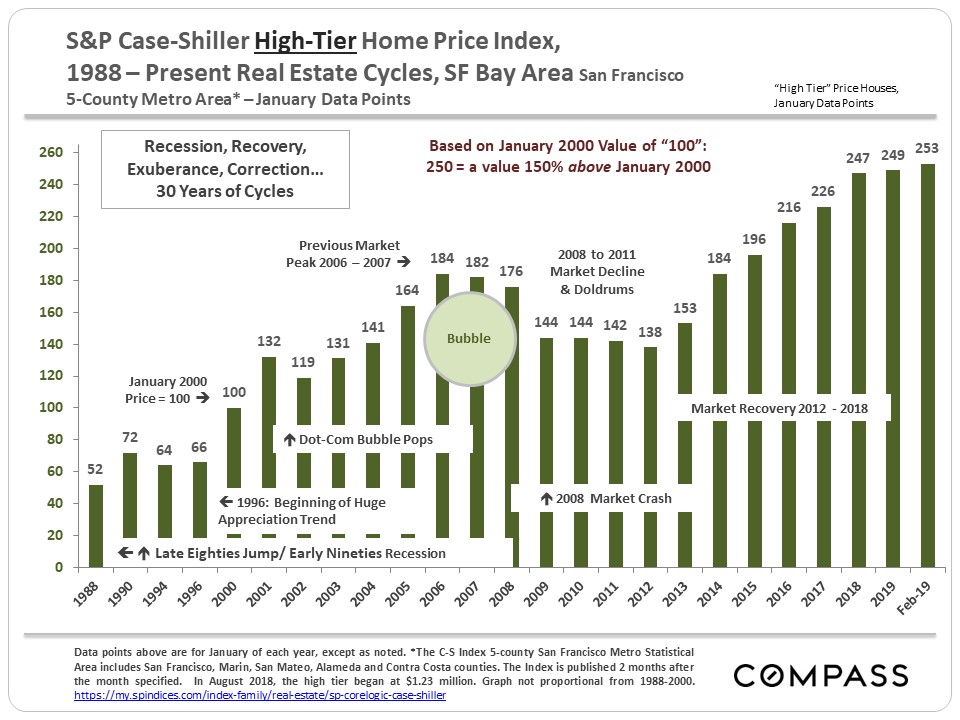
84% appreciation, 2000 - 2007, and 25% decline, acme to bottom.
Now far above previous 2007 peak values.

All our real estate marketplace reports can at present be found here:
San Francisco Bay Expanse Real Estate Market Reports - Compass These analyses were made in expert organized religion with information from sources deemed reliable, merely they may comprise errors and are bailiwick to revision. All numbers are approximate and percentage changes will vary slightly depending on the exact begin and end dates used for recoveries, peak prices and bottom-of-market values.Compass is a existent estate banker licensed by the State of California, DRE 01527235. Equal Housing Opportunity. This report has been prepared solely for data purposes. The information herein is based on or derived from information generally available to the public and/or from sources believed to exist reliable. No representation or warranty can be given with respect to the accuracy or abyss of the information. Compass disclaims any and all liability relating to this written report, including without limitation whatever express or unsaid representations or warranties for statements independent in, and omissions from, the report. Naught contained herein is intended to be or should be read as any regulatory, legal, tax, accounting or other communication and Compass does not provide such communication. All opinions are field of study to change without notice. Compass makes no representation regarding the accuracy of whatever statements regarding any references to the laws, statutes or regulations of any country are those of the author(south). Past functioning is no guarantee of time to come results.
Copyright 2019 Compass
Source: https://www.bayareamarketreports.com/trend/3-recessions-2-bubbles-and-a-baby
0 Response to "San Mateo Ca Real Estate Market Review 2018"
Post a Comment